The solutions to a
better future.
See our past award-winning cars.

Perry the PlatyBus
2025-2026
Perry the platybus is powered by a lead acid battery, with a high cell potential up to an astounding 2.1V. The power generated by the lead acid battery is then connected to a rotary motor, promoting an instantaneous acceleration of our system. The stopping mechanism features a Briggs-Rauscher reaction and a predetermined initial chemical concentration needed for a desired length of time. Alongside electrical engineering, a light sensor is used to detect the number of cycles elapsed and power to the motor is cut off.
-
3rd Place at AIChE Western Regionals


"Monster" Truck
2025-2026
Featuring a zinc-alkaline battery propulsion system, our Monster Truck runs off the electrochemistry principles learned in chemistry. With an energy dense battery composed of zinc plates, manganese dioxide powder, and alkaline potassium hydroxide electrolyte, Monster Truck has a voltage output of 1.5V. The key behind Monster Truck is the Monster reaction, synthesized from permanganate and glucose from a monster energy drink. A photodiode placed outside a vial containing this reaction senses the color change of the reaction from pink/purple to clear, cutting the power to the motor.
-
6th place at AIChE U.S. Western Regionals
Wanda
2024-2025
Wanda is powered by a hydrogen fuel cell with the anode made of platinum and cathode of powderized carbon separated by a proton exchange membrane. The car is then stopped using a photosensor that detects the transparency of solution and amount of LED light coming through.
-
7th place at AIChE U.S. Western Regionals


COSMO
2024-2025
Using an Aluminum-air battery, COSMO's motor is powered by the oxidation of Aluminum and reduction of Oxygen in the air. Utilizing Iodine and thiosulfate ions in reaction, the complex formed with starch produces a deep blue indicator, effectively increasing the transparency for LED light to pass through the cuvette. A photodiode measures the light level, signaling a stop for the motors once a specific value is reached.
-
7th place at AIChE U.S. Western Regionals
Popeye Jr.
2023-2024
The second edition of Popeye runs on an Aluminum-air battery to power the motor based off the principles of oxidation-reduction reactions. It again takes advantage of oxidizing the chlorophyll in spinach with bleach to create a color gradient, which is measured by a photodiode to determine when the motor should stop.
-
11th place at AIChE U.S. Western Regionals


AARON
2022-2023
As two ends of a conductor are held at different temperatures, the electrons at the hot junction at higher thermal velocities diffuse the cold junction, producing an EMF between the two ends. Dry ice was used as the cold junction and a neutralization as the hot junction. Due to the heat energy produced by this effect, heat energy could be converted into electrical energy, powering the car's motor. With a side formation of a black-blue complex of starch-iodide, the intensity of LED diminishes, leading to an increased resistance of LDR, stopping the car.
-
11th place at AIChE U.S. Western Regionals
Popeye
2022-2023
Ever so strong, Popeye runs on a Hydrogen fuel cell that generates electricity by combining Hydrogen and Oxygen to create the drive needed for a propulsion mechanism. Using bleach, the chlorophyll in spinach is oxidized, turning it transparent, allowing more light from the LED to pass through the cuvette. A photodiode is then used to measure the amount of light, signaling a stop to the motor at a specified value.
-
2nd place at AIChE U.S. Western Regionals


Spring Roller
2018-2019
Generated Hydrogen is used to power a fuel cell, combining oxygen and hydrogen to yield a voltage and power the motor. For Spring Roll's stopping mechanism, Luminol is mixed with bleach to create a chemiluminescent reaction. As the light from the reaction crosses a certain threshold, a signal will be sent to the car to start and stop. The bleach concentration is calculated to control the length of light-producing reaction, and therefore the time which the motor runs.
-
6th place at AIChE U.S. Western Regionals
Triple A
2018-2019
Triple A runs on an Aluminum-Air battery that generates electricity by oxidizing Aluminum at the anode with Oxygen from the air at the cathode. Like its sister car Spring Roller from the 2019 Regionals competition, it relies on a Luminol stopping reaction to determine how long the car will run.
-
12th place at AIChE U.S. Western Regionals


Fuel's Gold
2017-2018
Fuel's Gold runs off of a Hydrogen fuel cell, where the fuel is generated using a electrolyzer made from a nafion membrane with Potassium Hydroxide as the electrolyte. Using an iodine clock reaction, the solution of ions turns a blackish-blue color which is sensed by a photosensor and a stop is triggered.
-
7th place at AIChE Western Regionals
The Car of Ice and Fire
2015-2016
The Car of Ice and Fire utilizes a hot-and-cold temperature gradient to drive a thermoelectric generator to produce electricity. It uses an Iodine clock reaction like the Bat Mobile from the same competition season, where a rapid color change is detected in order to force the car to stop.
-
8th place at AIChE Western Regionals


Bat Mobile
2015-2016
Powered by a Magnesium-Copper battery system, the car utilizes cells comprised of Magnesium anodes and Copper cathodes to produce energy required to power the car. The intense Bat Mobile is stopped by an Iodine clock reaction, with the solution turning a dark blue color to trigger a stop.
-
8th place in AIChE. U.S. Western Regionals
Pink Panther
2014-2015
Using the team's chemically engineered Zinc-air batteries and Sodium Hydroxide as an electrolyte, cells are connected parallel in series creating a mini battery propulsion system. With Hydrochloric acid and Sodium thiosulfate mixed in a solution, the gradually opaque solution serves as a timer for the photosensor's stopping mechanism.
-
4th place in AIChE U.S. Western Regionals


The Great Gassby
2014-2015
A propulsion system controlled by a reaction between citric acid and Sodium bicarbonate. At a determined psi, gas is released into a turbine, converting the reaction's pressure output into useful mechanical energy for the gear shaft.
-
3rd place in AIChE U.S. Western Regionals
-
29th place in AIChE U.S. Nationals

Tritonium
2013-2014
Featuring a PEM fuel cell for its propulsion mechanism, Tritonium relies on the conversion of Hydrogen and Oxygen into electricity. The stopping mechanism is electrically controlled with a pressure-syringe system, where a pressure threshold is used to stop the progress of the car.
-
6th place in AIChE U.S. Western Regionals


The Lorax
2012-2013
The Lorax relies on a thermoelectric propulsion system, featuring a chemical generator and a 12V thermoelectric module. An elephant toothpaste reaction and transistor triggers the car's stopping mechanism, programming The Lorax to shut off at constant speed.
-
8th place at AIChE Western Regionals
-
3rd place at Poster Competition
2011-2012
Triton Car
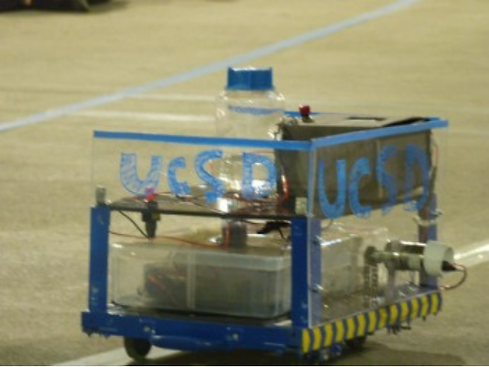
The first ever UCSD ChemE Car. Powered by a simple Zinc-Carbon battery and stopped with an Iodine clock reaction, Triton Car was created by our first team of engineers.
-
6th in U.S. Western Regional competition
-
"Most Creative Drive System" awarded